Forget your average houseplant — the Venus Flytrap is a tiny predator with a taste for insects. Found in the wetlands of North and South Carolina, USA, this plant survives in nutrient-poor soil by catching bugs — basically nature’s ultimate DIY fertilizer. But how does a Venus Flytrap actually work, and what does it eat to survive?
How Does a Venus Flytrap Work?
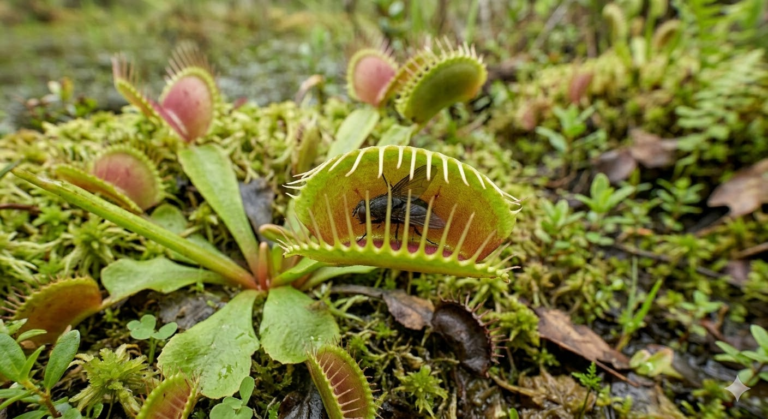
The Venus Flytrap’s leaves are lined with tiny trigger hairs. When an insect touches the hairs twice, the trap snaps shut in under a second. Once trapped, the plant secretes digestive enzymes to absorb nutrients over 5–12 days, giving it the nitrogen and minerals it can’t get from soil.
Quick fact: The plant only closes when it’s sure there’s prey inside — it’s energy-smart.
Quick breakdown of the trap mechanics:
- Open leaves are convex (curved outward)
- Triggered twice → leaves snap concave (forming a trap)
- Action potentials travel across the lobes, signaling cells to contract or expand
- Once closed, the plant secretes digestive enzymes over several days, extracting essential nitrogen
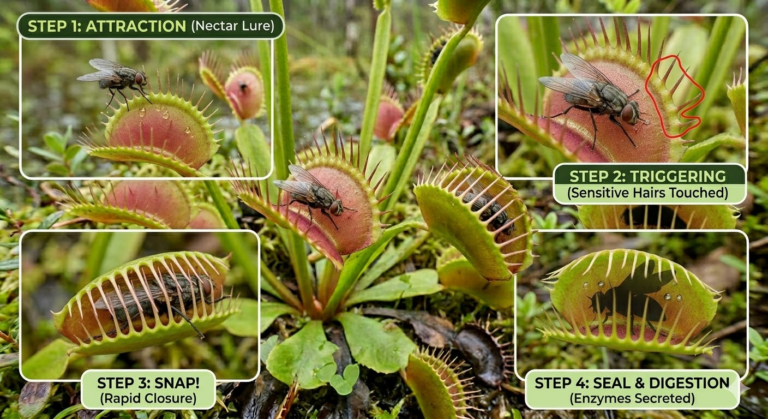
This is exactly how a Venus Flytrap works, using trigger hairs and rapid movement to capture prey. Essentially, it remembers touches for a few seconds — a rare “memory” in plants!
Where Do Venus Flytraps Grow?
Venus Flytraps are native to a very small region in the wild, mainly the wetlands of North and South Carolina in the United States. They grow in humid, acidic environments like bogs and swampy areas where the soil is poor in nutrients. Because of these harsh conditions, they evolved their ability to trap insects for food instead of relying on soil nutrients. In the wild, they are rare and tightly restricted to specific habitats.
What Does a Venus Flytrap Eat
In the wild, a Venus Flytrap eats small insects such as flies, ants, beetles, and spiders. These prey provide essential nutrients like nitrogen and phosphorus that the plant cannot get from the poor soil it grows in. It mainly targets crawling or flying insects that trigger its sensitive trap mechanism. Once captured, the insect is slowly broken down by digestive enzymes over several days, allowing the plant to absorb the nutrients it needs to survive.
The Name and Origins
The name of this plant reflects both its unique characteristics and the history of its discovery. Early explorers and botanists often named it based on its appearance, habitat, or local uses. Its origins trace back to regions where it was first documented by indigenous peoples and later recorded in European writings, highlighting the blend of local knowledge and early scientific observation.
- Common name: Venus Flytrap — named after Venus, the Roman goddess of love
- Scientific name: Dionaea muscipula
Dionaea = “daughter of Dione” (Greek goddess Aphrodite)
Muscipula = Latin for “flytrap” or “mousetrap” - Historical indigenous names: Tipitiwitchet or tippity twitchet, likely from Cherokee or Catawba words, referencing how the leaves wrap around prey
Venus Flytrap Care Guide
If you’re wondering how to take care of a Venus Flytrap, the key is to mimic its natural environment as closely as possible. Even tiny predators need care. Here’s how to keep your Venus Flytrap healthy
- Sunlight: Needs at least 4–6 hours of direct sunlight daily.
- Water: Only rainwater or distilled water — tap water can kill it.
- Soil: Acidic, low-nutrient soil (peat moss + sand) mimics its natural environment.
- Dormancy: In winter, the plant goes dormant, shedding leaves to save energy for spring.
If you ever see a trap that won’t snap anymore, don’t panic — it’s probably old and will be replaced by new leaves.
Venus Flytrap Plant Facts
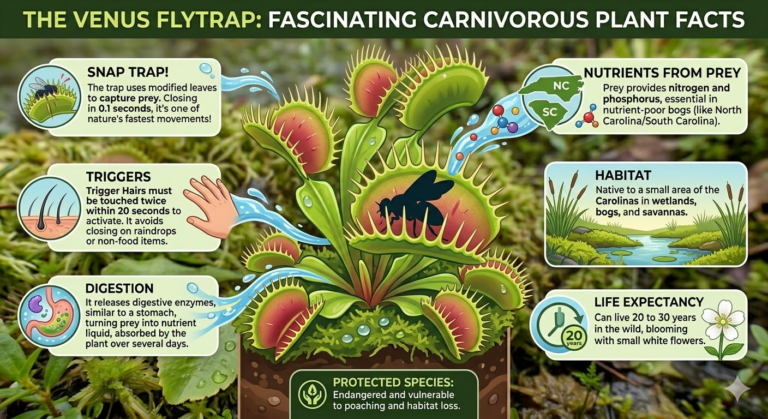
The Venus Flytrap isn’t just any plant — it’s a tiny predator with one of nature’s fastest moves. From snapping traps to digesting prey, this plant has evolved incredible ways to survive in nutrient-poor wetlands.
How long does a Venus Flytrap live?
With proper care, it can live for 20 to 30 years, going through yearly dormancy cycles.
- Snap Trap: Leaves snap shut in 0.1 seconds to catch insects.
- Trigger Hairs: Must be touched twice within 20 seconds to activate the trap.
- Digestion: Enzymes break down prey into nutrients over several days.
- Habitat: Native to wetlands and bogs in North and South Carolina.
- Nutrients: Prey provides essential nitrogen and phosphorus.
- Life Expectancy: A long-living carnivorous plant that can survive for decades under proper conditions.
- Protection: Endangered and vulnerable to poaching and habitat loss.
Why Venus Flytraps Are Fascinating
Venus Flytraps are living proof that even small carnivorous plants can survive in extreme and nutrient-poor environments. They rely on fast snapping traps and digestive enzymes to capture and break down insects for survival. What makes them even more interesting is how they can distinguish real prey from false triggers, avoiding unnecessary energy use. This combination of speed, precision, and adaptation shows how advanced plant survival strategies can be in nature.
Final Thoughts
From snapping traps to digesting prey, the Venus Flytrap is more than just a curious plant — it’s a master of survival in harsh conditions. Its clever hunting techniques and delicate care needs make it a remarkable example of nature’s ingenuity.
Curious how this tiny predator catches its prey? Watch the Venus Flytrap in action!
For more carnivorous plant facts and amazing plant survival strategies, visit Too Lazy Plants.